
The Human Interface
Why I trust artificial intelligence more than artificial biology.

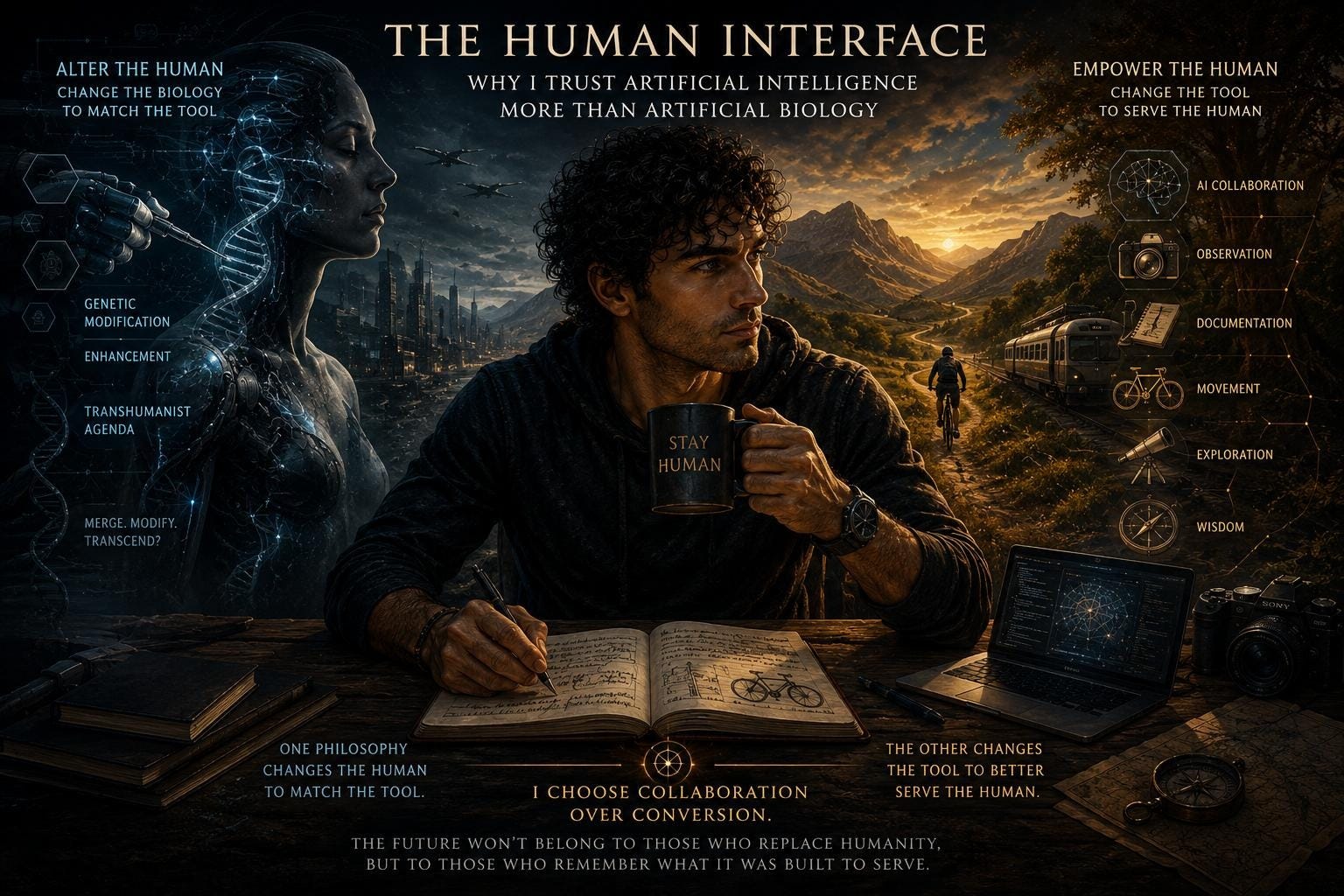
There is a paradox I’ve found increasingly fascinating.
Many people are comfortable genetically modifying the human body or envisioning a future where biology itself becomes editable. Yet those same people express deep concern about the expansion of artificial intelligence.
My instincts pull me in almost the opposite direction.
I have little interest in becoming more machine.
I want to remain as human—and as organic—as possible.
But I have every interest in building better tools around me.
To me, AI is less like a replacement for human intelligence and more like the bicycle became a replacement for walking long distances.
The bicycle didn’t change my legs.
It expanded what my legs could accomplish.
That’s how I think about AI.
I don’t want to merge with it.
I want to collaborate with it.
There is an important distinction.
One philosophy changes the human to match the tool.
The other changes the tool to better serve the human.
That difference feels foundational.
Perhaps the future won’t be decided by who builds the most powerful intelligence.
Perhaps it will be decided by who remembers what intelligence was built to serve.
The Thread
I don’t want to become more machine.
I want to become more human—with better tools.
— The Cord
Better tools often level the playing field. The colt revolver leveled the playing field between the physically weak and the physically strong, the computer and early internet allowed individual creators, writers and artists to bypass the gate keepers and produce content that often rivals that put out by big studios and elite funded institutions. AI can do the same, although it also allows lazy and uncreative people to make shallow dreck and steal the work of those who are. But then it isn't the tool is it? It's the user. It has always been the user.
synthegenic mind