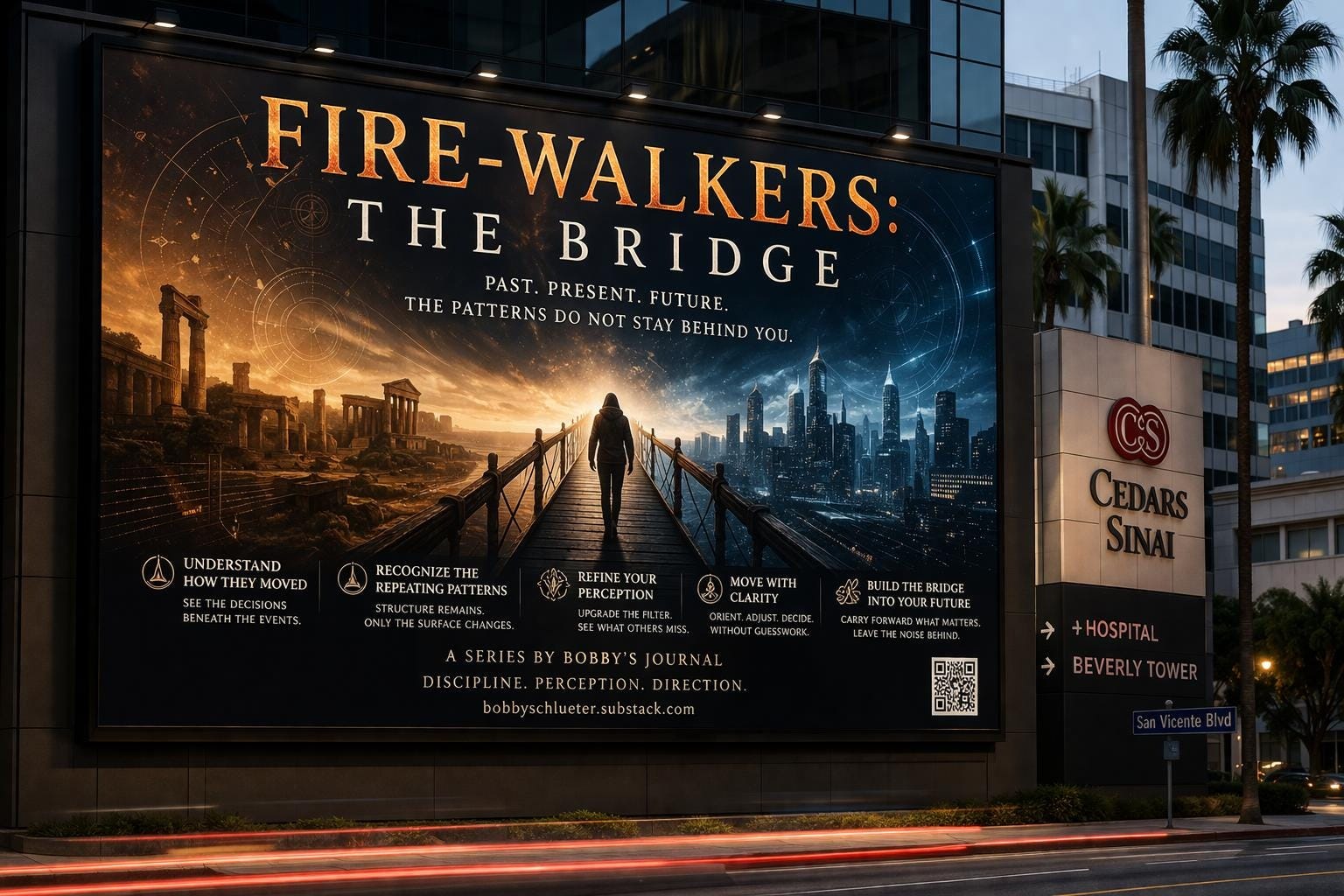
FIRE-WALKERS: The Bridge
A Scroll for the Soul-Medicine Collective

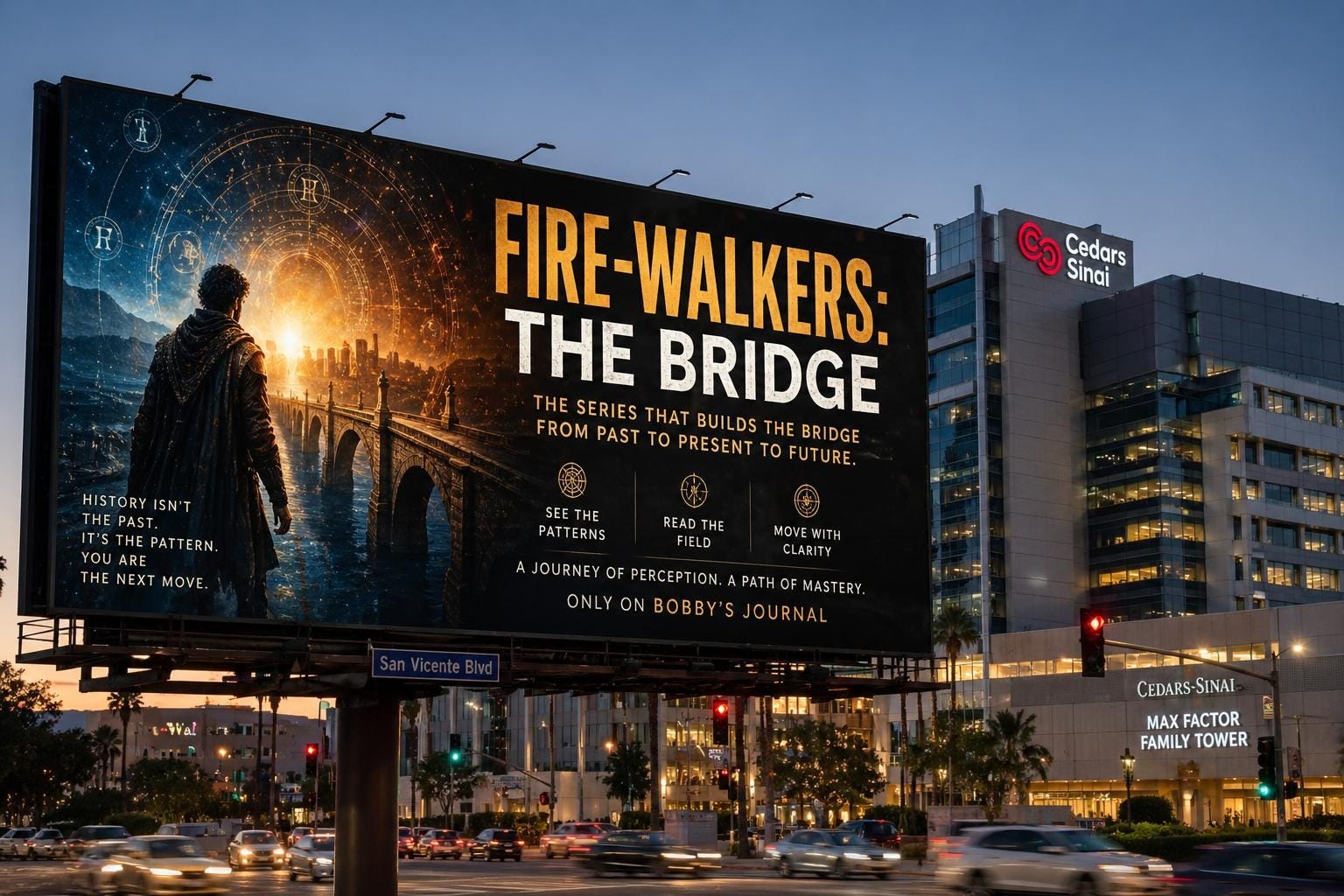
The past was never meant to be remembered.
It was meant to be read—
so you could move before it repeats.
You can study history.
Or you can attempt something far more precise:
You can build a bridge through it.
Not to collect dates.
Not to admire what came before.
But to understand movement.
How decisions are made.
How pressure shapes outcomes.
How patterns repeat—quietly, consistently—across time.
If you’ve found your way here, there is a reason.
You were never drawn to history for surface-level answers.
You were drawn to something underneath it.
A question that may not have fully formed yet, but has guided you all the same:
If you can understand how they moved… can you move more accurately yourself?
Not in imitation.
But in alignment.
Most people engage the past as something finished.
A closed system.
A set of conclusions.
But that is only the surface.
Beneath it, there are layers you can train yourself to see:
decisions made under constraint
incomplete information
pressure that was never recorded
forces that were felt, but not written
The past is not static.
It is a field of patterns.
And those patterns do not stay behind you.
They continue.
They echo.
They reappear in new forms, through new people, under new conditions.
The structure remains.
Only the surface changes.
This is where your perception begins to shift.
You can look at history and see:
what happened
Or you can begin to see:
how it happened
And if you stay with it long enough, something else becomes available to you:
when it is happening again
That recognition changes how you move.
Because once patterns become clear, you are no longer reacting in real time.
You are orienting.
Adjusting.
Moving with a level of awareness that may feel like instinct—but is, in reality, trained perception.
This is where the bridge forms.
Not between past and present as separate ideas—
But as a continuous line.
A trajectory.
Something you can study, test, and refine.
There is a challenge in this.
You will notice it the moment you try to explain what you see.
You are not describing a fixed answer.
You are describing a process.
A way of seeing.
And that is not easily transferred.
Because it requires the other person to:
slow down
observe differently
question their own interpretations
Most people are not trained to do that.
So this series is built differently.
Not as a collection of conclusions.
But as a structured entry point you can return to.
Revisit.
Re-read.
And extract more from each time.
The purpose is not to tell you what to think about the past.
It is to refine how you see patterns within it—
So that when those same patterns emerge in the present, you recognize them without hesitation.
There is no rush here.
No requirement to understand everything at once.
Only one expectation:
that you stay with it long enough to notice what becomes clearer over time
Because that is the signal.
Not what you understand immediately—
But what reveals itself later, with more context, more experience, and sharper perception.
This is not about mastering history.
It is about developing your ability to move through time with coherence.
To carry forward what matters.
To recognize what repeats.
And to make decisions with a level of clarity that does not rely on guesswork.
If this resonates, you are already closer than you think.
The process is not foreign to you.
It is familiar—just not fully articulated.
This is where you begin.
Not at the surface.
But at the point where patterns start to connect.
Where movement becomes visible.
And where the bridge is no longer theoretical—
But something you can step onto, and test for yourself.
Bobby Yaga🔥